
Creating a marketing plan sounds like it should take a whole weekend, a stack of templates, and a business degree. It doesn’t.
If you’re building this business around a full-time job, squeezing marketing into evenings and lunch breaks rather than working it as a nine-to-five, you don’t need a 50-page strategy document. You need something simple enough that you’ll actually open it again next week.
A good marketing plan for a small business does one job: it tells you what to do, when to do it, and why, so you’re not starting from a blank page every Sunday night wondering what to post.
Here’s what you’ll walk away with:
- A simple framework for building your plan from scratch
- Which marketing strategies for a small business are actually worth your limited time
- A practical way to organise it all with a marketing calendar, so nothing falls through the cracks
Let’s build it.
What Is a Marketing Plan for a Small Business?
A marketing plan for a small business is your roadmap for how you’ll attract, engage and convert customers over a set period. Instead of posting whenever inspiration strikes (or panic hits), it gives you clear direction.
Think playbook, not business document. It answers:
- Who’s your ideal customer?
- Which channels are you actually focusing on?
- What content are you creating?
- When’s it going out?
- How will you know it’s working?
The best marketing plans are the ones you’ll actually look at again. A one-page plan you review monthly beats a 40-page document gathering dust in a folder.
It’s also worth knowing this isn’t just a nice-to-have. CoSchedule’s own research into marketer success found that people who document their strategy are over four times more likely to report success than those who don’t, and the most organised marketers are nearly seven times more likely to succeed than their peers. Having a plan, even a scrappy one, genuinely moves the needle.
The Myths Keeping You From Starting
- “I need to be everywhere.” You don’t. Two or three channels where your people already hang out beats a scattered presence across ten.
- “I need a big budget.” Consistency outperforms budget at this stage. Every time.
- “I have to plan a whole year.” Plan a quarter. Adjust as you learn.
- “Once it’s set, it’s set.” Your plan should change as you find out what’s actually working.
A plan doesn’t need six months of prep. It needs six honest ingredients:
- Goals: what you want your marketing to achieve
- Audience: who you’re trying to reach
- Strategies: which channels and tactics you’ll use
- Content: what you’ll create
- Campaign planning: how activities group around specific objectives
- Measurement: how you’ll know it’s working
Once these are in place, marketing stops being a guessing game and starts being a repeatable process. That’s what we’re building.
Step 1: Set One Clear Goal
Every effective marketing plan starts here, and most beginner plans skip it. That’s exactly why they collapse by week three.
Before you touch a single channel, ask: what business outcome am I actually trying to achieve?
Vague goals like “post more” or “go viral” give you nothing to plan against. Use the SMART shape instead: specific, measurable, achievable, relevant, time-bound.
❌ Get more website traffic.
✅ Increase organic traffic by 20% over six months by publishing two SEO blog posts a month.
The second one tells you exactly what to do this week. That’s the whole point.
Pick one primary goal per quarter. Not five. One. Everything you plan in the next three steps should serve that single goal. That’s what keeps a solo marketing effort focused instead of scattered.
Step 2: Get Specific About Who You’re Talking To
Marketing to “everyone” is the fastest way to waste your limited hours. The more specific you are about who you’re serving, the easier every other decision gets.
You don’t need a 20-question buyer persona. Just answer:
- Who’s your ideal customer?
- What problem are they trying to solve?
- What would stop them saying yes?
- Where do they actually spend time online?
And shift how you talk about what you do. Customers care about outcomes, not features:
Instead of “I offer 1:1 coaching calls,” say “I’ll help you get your first three paying clients without the guesswork.”
That reframe alone makes your content more persuasive without changing a single service.
Step 3: Pick Your Channels (Not All Of Them)
More channels doesn’t mean better results. The businesses that grow steadily do a handful of things properly rather than showing up half-heartedly everywhere.
Use your time as the deciding factor:
| If you have… | Focus on… |
| 5 hours a week | One platform + email marketing |
| 10 hours a week | Add SEO-driven content and basic analytics |
| More time/support | Layer in paid promotion once the basics are working |
Content marketing and email are the two that compound. They’re still working for you weeks after you hit publish, unlike a social post that’s gone in a day. If you’re only picking two things to start, pick those.
Step 4: Build a Content Plan You’ll Actually Follow
Knowing your channels is only half the job. The next question is what you’re actually publishing, and deciding that on the fly every week is how content plans quietly die.
Pick three to five content pillars: the core topics everything you create sits under. If you’re a coach, that might be client results, mindset, and the practical how-to of your niche. Three to five pillars gives you enough range without reopening the “what do I even talk about” question every time.
Build a simple, repeatable workflow so you’re not reinventing the process each time:
- Brainstorm ideas (keep a running list, don’t start from zero each week)
- Choose a topic that supports this quarter’s goal
- Draft it
- Edit
- Publish
- Promote it across your channels
- Repurpose it into 2–3 other formats
Plan a month at a time. You don’t need a year mapped out. Four to six weeks ahead is enough to feel organised without it becoming another rigid system to maintain.
Step 5: Build a Marketing Calendar You’ll Actually Maintain
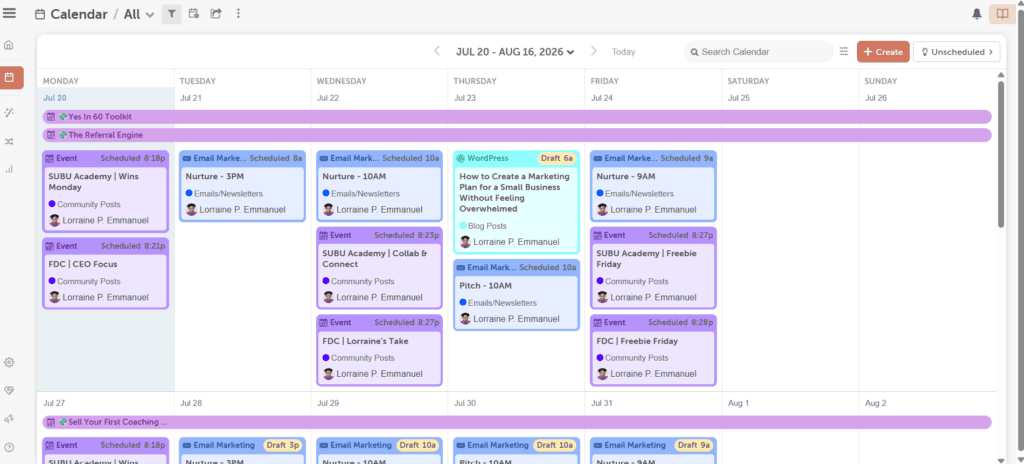
A marketing calendar is what turns your plan from an idea into something that actually happens. Without one, it’s easy to lose track of deadlines, forget a promotion, or realise you haven’t published in three weeks.
The goal isn’t to schedule every minute. It’s enough structure that your marketing keeps running even when life gets busy.
What to put on it:
- Publishing dates
- Email sends
- Social content
- Launches and promotions
- Your weekly or monthly review slot
Quarterly planning gives you the big picture (launches, seasonal pushes, priorities). Monthly planning is where the actual doing happens: scheduling, assigning, adjusting.
A spreadsheet works fine when you’re starting out. But if you’re constantly asking yourself “did that newsletter go out?” or “when’s that post supposed to go live?”, it’s a sign you’ve outgrown it.
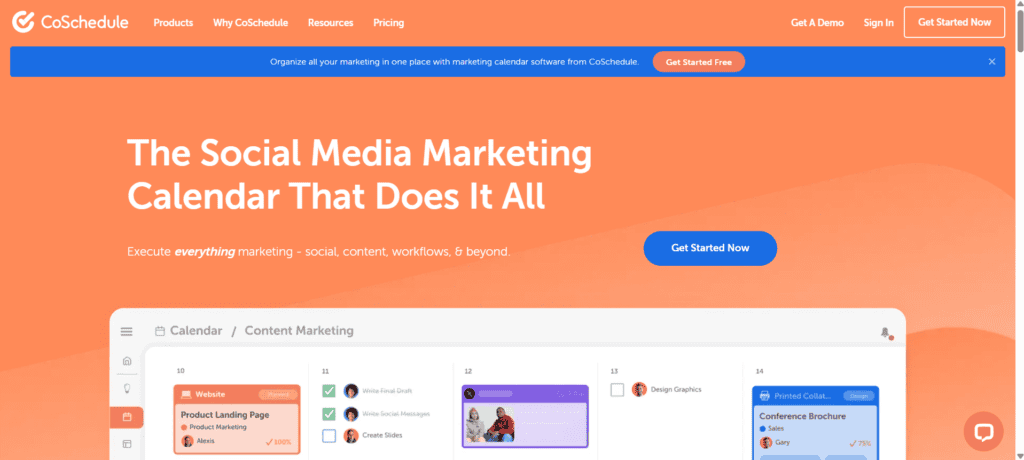
That’s where a tool like CoSchedule earns its keep — it puts your calendar, your content, and your task list in one place instead of three different tabs. If you’re the kind of person juggling this alongside a job, having one source of truth, rather than a spreadsheet plus your notes app plus your memory, is the difference between marketing that happens and marketing that gets forgotten.
Related reading: if you’re weighing up planning tools, automation software, and everything else in the mix, check out our pillar guide, Best Online Marketing Tools for Small Business in 2026, which breaks down the full stack.
Review your calendar weekly. Fifteen minutes, same time each week: check what’s coming, reschedule what slipped, add new ideas while they’re fresh. It’s a small habit that keeps you proactive instead of firefighting.
Step 6: Plan Campaigns Instead of Random Activity
Treating every post and email as its own separate task keeps your channels busy but rarely moves the needle. A campaign groups activity around one goal, so everything’s pulling in the same direction instead of just filling space.
Before creating anything, answer:
- What’s the goal? (100 new subscribers, 20 discovery calls, one product launched)
- Who’s it for? Get specific.
- What’s the one-sentence message? Every asset should repeat it.
- What do you actually need? One cornerstone post, a landing page, a few emails, a handful of social posts, not dozens of moving parts.
- How will you know it worked?
A campaign can be as small as one blog post, one email, and three social posts pointed at the same goal. It doesn’t need to be complicated to be effective. And if something worked once, reuse it: refresh the stats, update the offer, run it again next quarter instead of starting from scratch.
Step 7: Measure Results and Adjust
Your plan isn’t a document you write once and forget. It’s something you check against reality.
Skip the vanity metrics (likes, follower counts) and track what actually reflects growth:
| Goal | What to track |
| Awareness | Organic traffic, reach |
| Leads | Sign-ups, subscribers, conversion rate |
| Sales | Revenue, conversion rate |
| Retention | Repeat purchases, churn |
Monthly, ask what worked, what didn’t, and what you should stop doing. Quarterly, zoom out: is this still serving the right goal, has your audience changed, what should you double down on?
Before you create more content, check whether refreshing what already exists would do more for you. Updating a strong-performing post with new examples or better SEO often beats writing something new from scratch.
Recommended Tools for Marketing Planning
The system matters more than the software. Most people start with a spreadsheet, and that’s genuinely fine, until you’re juggling multiple campaigns and it stops being enough.
CoSchedule brings your calendar, content planning, and task management into one workspace instead of scattered across separate tools. If you’ve outgrown the spreadsheet-plus-sticky-notes stage, it’s worth a proper look.
For the full breakdown of planning platforms, email tools, and everything else that might belong in your stack, read our pillar guide: Best Online Marketing Tools for Small Business in 2026.
The Bottom Line
A marketing plan doesn’t need to be complicated to work. It needs to be one you’ll actually stick to. Set one clear goal, get specific about who you’re talking to, pick a couple of channels and do them properly, and use a calendar that keeps you honest.
That’s it. That’s the plan. Everything else is detail you can add once this is running.
Once your plan’s in place, the next step is choosing the tools that make it easier to execute. Head to Best Online Marketing Tools for Small Business in 2026 for the full stack, including where CoSchedule fits in.
Frequently Asked Questions
How long should a marketing plan be for a small business?
Short enough that you’ll actually reread it. A single page covering your goal, audience, channels, and calendar is plenty when you’re running this solo. Save the 40-page strategy documents for businesses with a marketing department to read them.
How often should I update my marketing plan?
Review it weekly (a quick check against your calendar), properly reassess it monthly, and do a full rethink each quarter. Your plan should flex as you learn what’s working, not sit untouched for a year.
Do I need a marketing plan if it’s just me running the business?
Especially then. Without a plan, solo marketing becomes reactive: you post when you remember, panic when sales dip, and burn hours deciding what to do instead of doing it. A simple plan removes that daily decision-making.
What’s the difference between a marketing plan and a marketing strategy?
Your strategy is the “why” and the big-picture direction: who you serve, what makes you different, where you’re headed. Your marketing plan is the “how”: the specific actions, channels, and calendar that bring the strategy to life week by week.
What tools do I actually need to build a marketing plan?
To start, nothing beyond a notebook or a spreadsheet. Once you’re juggling multiple channels and campaigns, a dedicated tool like CoSchedule earns its place by keeping your calendar, content, and tasks in one system instead of scattered across five.